Turmeric (Haldi)
The most visually distinctive spice in Indian cooking — that vivid yellow-orange is turmeric. Used in virtually every Indian savory dish, but primarily for color and its mild earthy background note rather than flavor. It's not a flavor-forward spice; its job is to set the color of the dish and add depth without announcing itself.
What it is
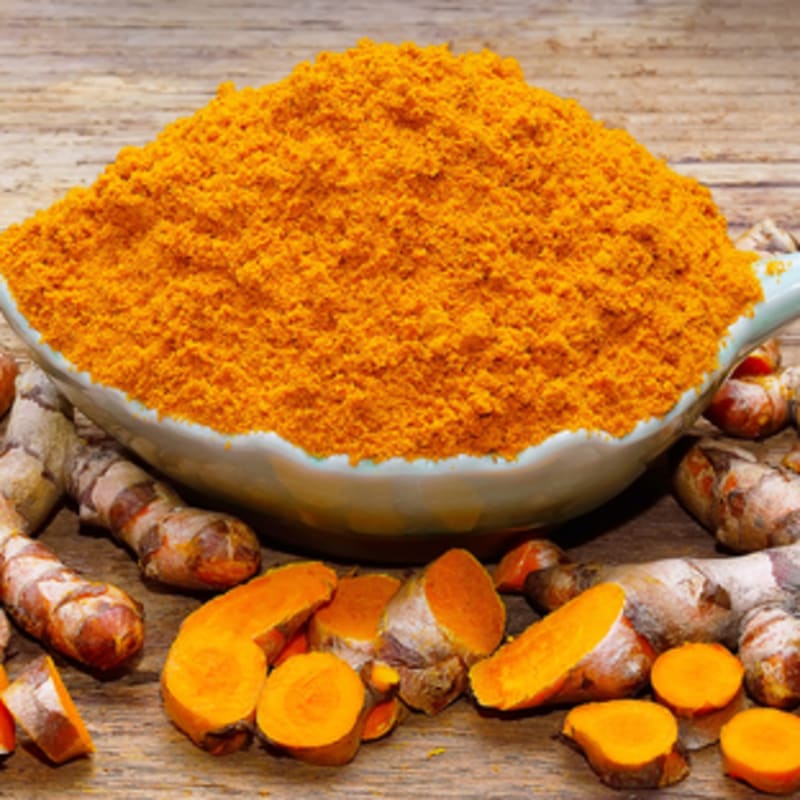
The dried, ground rhizome of Curcuma longa, related to ginger. Available as a bright orange-yellow powder or as fresh rhizomes (similar to fresh ginger). The dried powder is standard for Indian cooking — fresh turmeric has a more vibrant color and sharper flavor but is less commonly used.
Flavour & Aroma
Raw: Earthy, slightly bitter, faintly peppery. Mild enough that it rarely dominates.
Cooked: The bitterness rounds out and it becomes a warm, earthy background note. It integrates into the dish rather than standing out.
The key point: turmeric is not a flavor spice in the same way cumin or coriander is. Its primary role is coloring the dish golden-yellow. The flavor is secondary — important, but subtle.
Too much: Turmeric becomes bitter and medicinal in excess. More is not better. Almost every Indian recipe uses 1/4 to 1/2 tsp regardless of the dish size — this is intentional.
When to add it
- With dry spices after aromatics: The standard approach. Add with cumin, coriander, and chilli powder after onions are cooked, fry briefly in oil before adding liquid.
- In marinades: Adds color to the protein from the outside. Combined with yogurt for tikka marinades.
- In boiling water for vegetables/lentils: Some recipes add turmeric directly to the cooking water — helps color and slightly reduces bitterness in lentils.
- Never as a finisher: Unlike cumin or coriander, turmeric should always be cooked. Raw turmeric powder is harsh.
What it contributes to a dish
Colour first, then depth. The golden-yellow of most Indian dals, curries, and rice dishes comes entirely from turmeric. A dish made without turmeric looks pale and anaemic even if the flavor is otherwise correct.
Beyond color it adds a mild earthy warmth that's part of the background flavor of Indian cooking — you'd notice its absence as a flatness rather than as "missing turmeric."
Works well with
- Cumin and coriander — the standard trio. Turmeric provides color; cumin and coriander provide the flavor base.
- Chilli (Kashmiri or regular) — the colors combine to give a deep orange-red.
- Black pepper — piperine in black pepper enhances curcumin absorption. Traditional pairing in Indian cooking long before this was understood scientifically.
- Ginger — both are rhizomes, both earthy; they complement each other.
- Coconut milk — turmeric colors it beautifully golden.
In blends
| Blend | Role |
|---|---|
| Garam masala | Sometimes included, sometimes not — regional variation |
| Pav bhaji masala | Included for color |
| Most curry powders | Always present — provides the characteristic yellow |
| Sambar powder | Background color and earthiness |
Forms & Storage
Ground turmeric powder The standard form. Bright orange-yellow when fresh, fading to a duller yellow with age. Shelf life: 6-12 months, but color fades noticeably after 6 months — if it looks pale, it's past its best.
Fresh turmeric rhizomes More vibrant color, slightly sharper and more aromatic than dried. Use 1 inch fresh = roughly 1 tsp dried. Stains hands and surfaces aggressively — wear gloves.
Should you roast it? No — turmeric is never dry-roasted. It burns easily and becomes intensely bitter.
Storage: Turmeric stains everything it touches. Store in a sealed jar inside a sealed bag or dedicated container. Bright orange-yellow color = fresh; pale yellow = old.
Substitutes
No true substitute for color. Saffron gives a different yellow, safflower gives a pale yellow — neither gives the warm orange-yellow of turmeric. For flavor only (not color), a pinch of ginger powder gets vaguely close but isn't equivalent.
Notes
- Staining: turmeric permanently stains fabric, plastic, and countertops. Treat spills immediately with dish soap. Wooden spoons and plastic containers become permanently yellow.
- Quantity discipline: 1/4 to 1/2 tsp is the standard for most dishes serving 4. More makes it bitter. Recipes that say "1 tsp turmeric" for 4 servings are usually wrong.
- Health notes: curcumin (the active compound) has anti-inflammatory properties that are well-studied but only meaningful in quantities far larger than used in cooking. Turmeric's value in Indian cooking is culinary, not medicinal.
Added Aug 31, 2026 · Updated Aug 31, 2026