Star Anise (Chakra Phool)
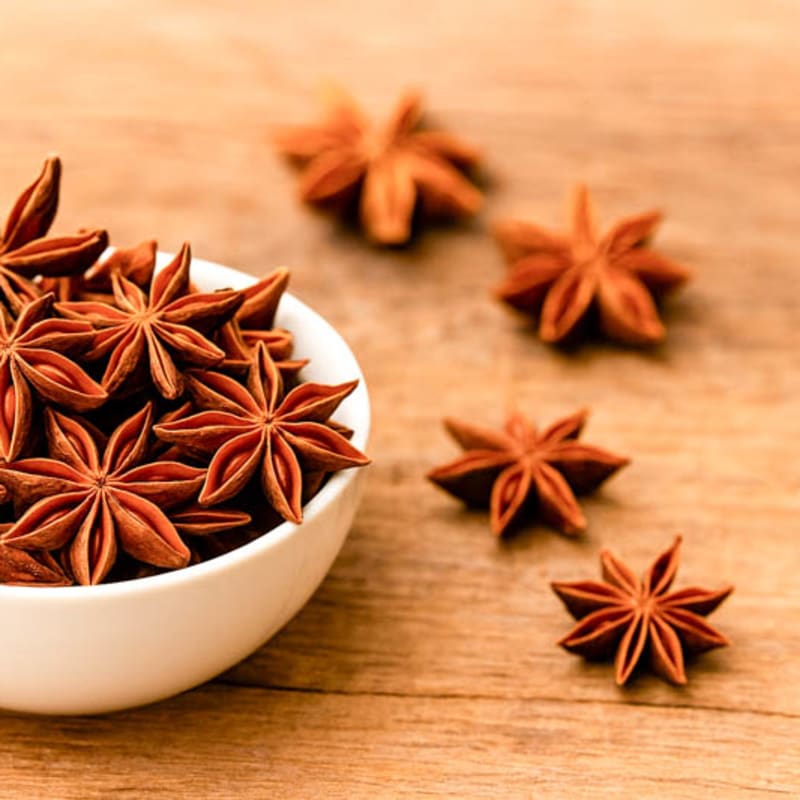
Star anise is the most visually distinctive spice in Indian cooking — the eight-pointed star shape is unmistakable. Its flavor is anise-like (sharing the compound anethole with fennel and anise seeds) but more intense and slightly different in character. In Indian cooking it appears primarily in slow-cooked meat dishes and some spice blends, always in small quantities — one or two stars is typically enough.
What it is
The dried fruit of Illicium verum, a small evergreen tree native to southwest China and northeast Vietnam. Each star has eight points, each containing one seed. The entire star (fruit wall and seed together) is used. Despite sharing an anise flavor profile with fennel seeds and anise, star anise is botanically unrelated to either — the similar flavor comes from the same chemical compound (anethole) appearing in different plants.
Flavour & Aroma
Whole: Intensely anise-like, slightly sweeter and more complex than fennel seeds, with a warm woody undertone. The aroma is strong — a single star can be smelled across a kitchen.
Bloomed in oil: Releases its oils quickly and powerfully. The anise note dominates but rounds into a sweet-spiced warmth.
In slow-cooked dishes: Mellows considerably. The intensity diminishes and it becomes a sweet, complex background note — one of the hardest to identify individual components in a well-made biryani.
The distinction from fennel: fennel seeds are mild and sweet. Star anise is more intense, slightly more complex, with a woody depth fennel lacks. They share a character family but are not interchangeable in equal quantities.
When to add it
- First or second in hot oil (tempering): Star anise burns faster than most whole spices — add it to hot oil first, alone for 30 seconds, then add other whole spices. It goes dark quickly; watch carefully.
- Whole in slow-cooked dishes: Biryani, nihari, haleem, some kormas. Added early, it infuses slowly and mellows beautifully. Remove before serving — biting into a star anise point is unpleasant.
- In spice blends: Ground into some garam masalas and biryani masalas. Used in small quantities — typically 1 whole star per batch of blend.
- In chai: Regional variation — some chai masalas include a small piece of star anise for complexity.
What it contributes to a dish
Sweet anise complexity and aromatic depth. In biryanis and Mughlai meat dishes, star anise is one of the components that creates the layered, complex aroma you can't fully identify. Remove it and the dish smells slightly simpler. Its contribution is most obvious in the top notes — the sweet anise smell that wafts up when you open a biryani pot.
It also has an affinity with fatty meats — the sweet anise character complements richness in a way that balances rather than adds to heaviness.
Works well with
- Cinnamon and cloves — the whole spice trio for biryani and Mughlai cooking. Star anise adds the sweet anise dimension.
- Black cardamom — both have complex aromatic characters that work together in slow-cooked meat dishes.
- Fennel seeds — same flavor family; used together in some blends for layered anise complexity.
- Lamb and beef — particularly good with fatty red meats.
In blends
| Blend | Role |
|---|---|
| Some garam masalas | Background complexity (not all versions include it) |
| Biryani masala | Often present — aromatic top note |
| Pav bhaji masala | Present in some versions |
| Chinese five-spice | Dominant component (different context entirely) |
Forms & Storage
Whole stars The standard form. Use whole stars for tempering and slow cooking. Break into pieces for blending. One whole star = approximately 1/2 tsp ground.
Ground star anise Less common in Indian cooking than whole. Loses potency quickly. Used in blends.
Storage: Whole stars in an airtight jar: 2-3 years. They keep well but lose their top aromatic notes over time. When a star smells woody rather than anise-like, it's old. Ground: 6 months.
Substitutes
- Fennel seeds: same anise character, milder — use 1 tsp fennel per 1 star anise. The depth and intensity will be less.
- Anise seeds: closer in intensity to star anise than fennel — use 1/2 tsp per 1 star.
- Chinese five-spice: contains star anise but also other components — not suitable as a substitute in Indian cooking.
Notes
- Burns easily: of all the whole spices used in tempering, star anise burns fastest. Either add it first alone briefly, or add it slightly after the others have started blooming.
- Remove from finished dishes: the texture of dried star anise — woody, brittle, slightly sharp-edged — is unpleasant to eat. Always remove whole stars before serving.
- Star anise vs anise seeds: these are different plants, different shapes, similar flavor. Don't confuse them. Star anise is the large star-shaped fruit; anise seeds are tiny oval seeds from a completely different plant.
Added Aug 31, 2026 · Updated Aug 31, 2026